
Why the arm is worth less on paper
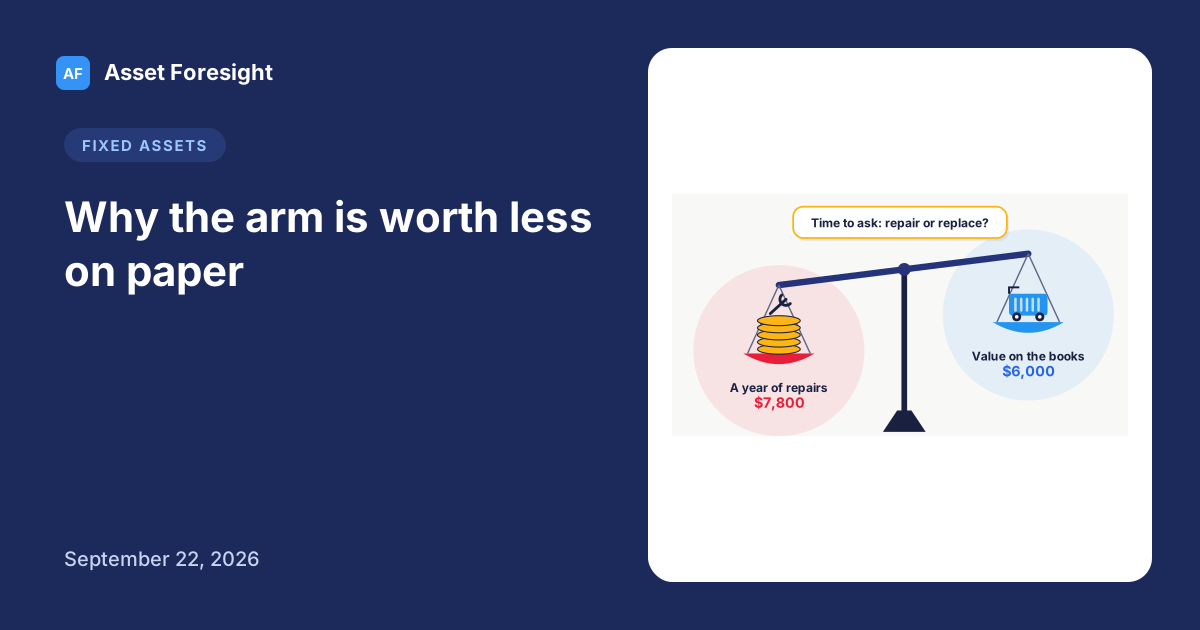
The rev-2 arm cost $60,000 in March of last year. A buyer offered $45,000 for it last week. The balance sheet says $30,000.
Three numbers describe one machine. All three are right—they just answer different questions.
The number on your books is a leftover, not a market price. When you buy hardware built to last, the cost doesn't hit your profit and loss statement all at once. It sits on your balance sheet, spread out month by month over the machine's expected lifespan. What remains is net book value—simply what is left of what you paid, on the schedule you picked.
You picked that schedule. The number on your balance sheet simply reflects a decision, often made in a hurry.
Here is the arithmetic. The arm cost $60,000 and was ready to use on March 1, 2025. You decided it would last three years, with zero salvage value. Divide $60,000 by 36 months, and you get $1,666.67 a month. From March 1, 2025 to September 1, 2026 is 18 months. Over 18 months, $30,000 has been depreciated, leaving $30,000 on the books.
Now change one variable. Say you had picked five years instead. That works out to $1,000 a month. After 18 months, you have depreciated $18,000, leaving $42,000 on the books. Same machine, same buyer. Yet the books say $30,000 or $42,000, entirely depending on a judgment call made before anyone ever switched the arm on.
Changing these timelines is ordinary. Amazon disclosed adjustments in both directions within about a year. Effective January 1, 2024, it extended server and network equipment life from five to six years, cutting 2024 depreciation by roughly $3.2 billion. Then, in its annual report filed February 7, 2025, Amazon shortened that lifespan back to five years starting January 1, 2025, citing rapid AI development. The 2025 effect was about $1.4 billion more in depreciation and $1.0 billion less in net income.
Book value still serves practical purposes. Sell the arm for $45,000 with $30,000 on the books, and you record a $15,000 gain. Lenders reconcile against it, and auditors start from it. An audit does not ask if three years was prophetic; it asks for evidence that three years was a deliberate decision made on a date by an authorized person.
What book value does not reflect is market worth. A specialized machine can sit above market price for years, while a well-kept one on a fast schedule sits far below it. Neither means the books are wrong. Meanwhile, your tax return uses a separate number under tax rules, which is your accountant's job.
Under the hood, multi-agent orchestration handles this workflow without mystery or guesswork. An orchestrator agent—acting like a project dispatcher—delegates sub-tasks to specialized worker agents. A document worker extracts the price and delivery date from the vendor's PDF invoice. The depreciation itself is not an agent's job: the ledger's own code computes it, straight-line, so no model ever produces the math.
Then comes the Agent-to-User Interface (A2UI). Rather than burying you in chat text, the agent generates an interactive review card right in your workspace. The card shows the price and dates the worker read and links the record back to the attached PDF invoice—an unbroken chain of custody called data provenance.
The AI never decides useful life on its own. Deciding whether hardware lasts three or five years is human judgment. A person reviews the card, chooses the useful life and saves the machine; from then on the ledger posts the monthly $1,666.67 by itself, worked out from what that person saved.
On Monday, pick your three most expensive machines. For each one, find the cost, the date it went into service, the lifespan assigned to it, and who made that call. If that last detail is missing, fix that first. Write down the reason right next to the years.
General information, not tax advice. Your accountant knows your situation.
Sources:
Amazon.com, Inc. annual report (Form 10-K) for fiscal 2024, filed 2025-02-07
Hudson Labs, "Amazon server depreciation", 2025
Anthropic, "Building Effective Agents", 2024
A2UI Protocol Specification and Architecture, 2025
W3C, "PROV-Primer: An Introduction to the PROV Data Model", 2013