
What walks out the door when your lab lead leaves?
In October, a supply chain student asked a manufacturing forum where real shop floors differ from the textbook (the thread). One answer stuck. A machinist who retired last year still gets called back twice a week. The setup sheets do not match how the machines really behave, and twenty years of his adjustments were never written down.
A hardware startup has the same person: the lab lead who built the test rigs, or the field engineer who knows which robot acts up. They rarely stay twenty years. In the United States, half of workers aged 25 to 34 had been with their employer for 3.0 years or less in January 2026, according to the Bureau of Labor Statistics.
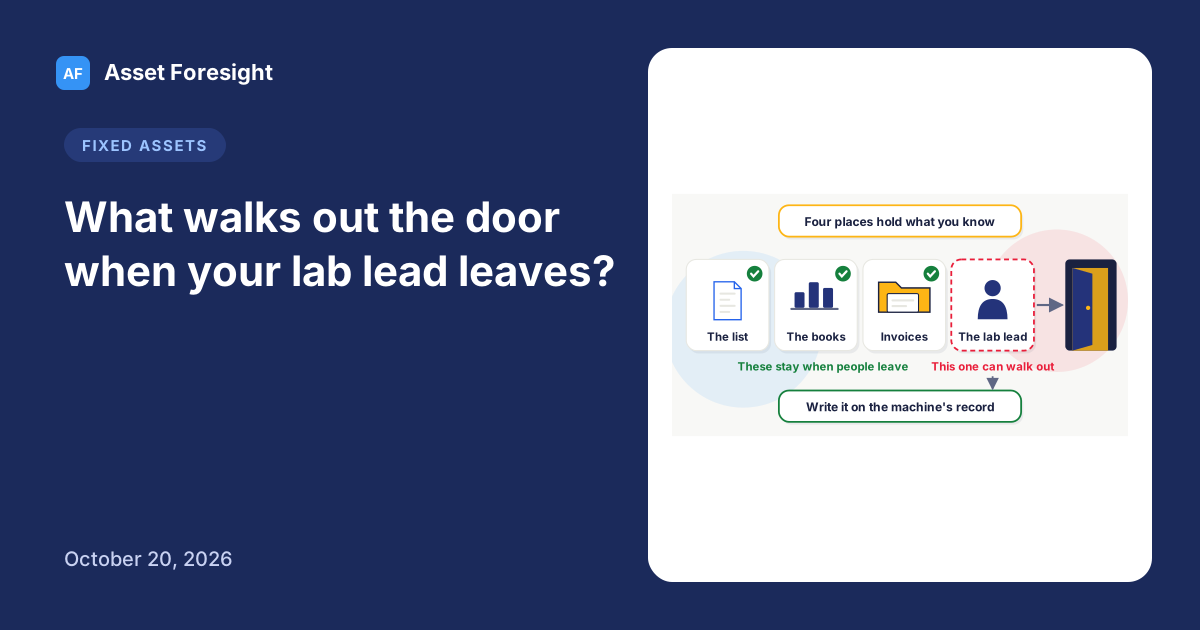
What a team knows about each machine sits in several places. There is the register, the list of every machine with what it cost and when you bought it. There is the accounting system, a folder of invoices, and the experience of the people who run the machines. Keeping them in step takes time, and only one of those places can resign.
Take an invented example: a robot arm bought in February 2025 for $60,000, with a 24-month warranty and a five-year expected life. Spread over 60 months, its value on paper drops $1,000 a month; accountants call that depreciation. After 19 monthly drops, at the end of August 2026, the arm is worth $41,000 on paper.
The lab lead who set it up leaves in June 2026. In September a joint starts grinding during an overnight run. The new engineer calls the supplier, who fits a new joint for $4,200. Finance books it, correctly, as a repair: an expense that month, with no change to what the arm cost. Nobody checks the warranty, which runs until February 2027. The term was on the purchase invoice in a shared folder, and the lab lead knew it without looking. The $4,200 is about a tenth of what the arm is worth on paper, and more than four months of its drop in value.
The fix is a habit before it is software: whatever happens to a machine goes on that machine's record, in the words of the person who saw it, with the paper attached. It has to be quicker than a message in a group chat, or the chat wins.
This is the kind of work a team of AI agents can take on. Picture a dispatcher handing jobs to specialists. The engineer photographs the arm's plate and the grinding joint and says what she sees. One agent gives the software eyes: it reads the serial number off the metal plate and suggests which machine on the register it matches. A person confirms the match; even a confident guess is never enough. A second agent files the fault on the arm's record, with the photo attached, and reads it back to her to correct. The warranty end date sits on that same record, so whoever pays the repair bill can see it runs until February 2027. Whether to make a claim is a person's call.
On Monday, pick your five most expensive machines. Sit with the person who knows each one best for ten minutes and fill in one page per machine. Write down the serial number from the plate, the cost and purchase date from the invoice, and when the warranty ends and who to call. Add the last repair and one thing a new person should know. Put the pages where whoever pays repair bills can see them, and add one rule: check the warranty date before paying a repair bill.
General information, not tax advice. Your accountant knows your situation.
Sources:
Bureau of Labor Statistics, "Employee Tenure in 2026", 2026-09-24
r/manufacturing, "The gap between textbook manufacturing and actual shop floor reality", 2026-10-20