
What does the lender want on the equipment schedule?
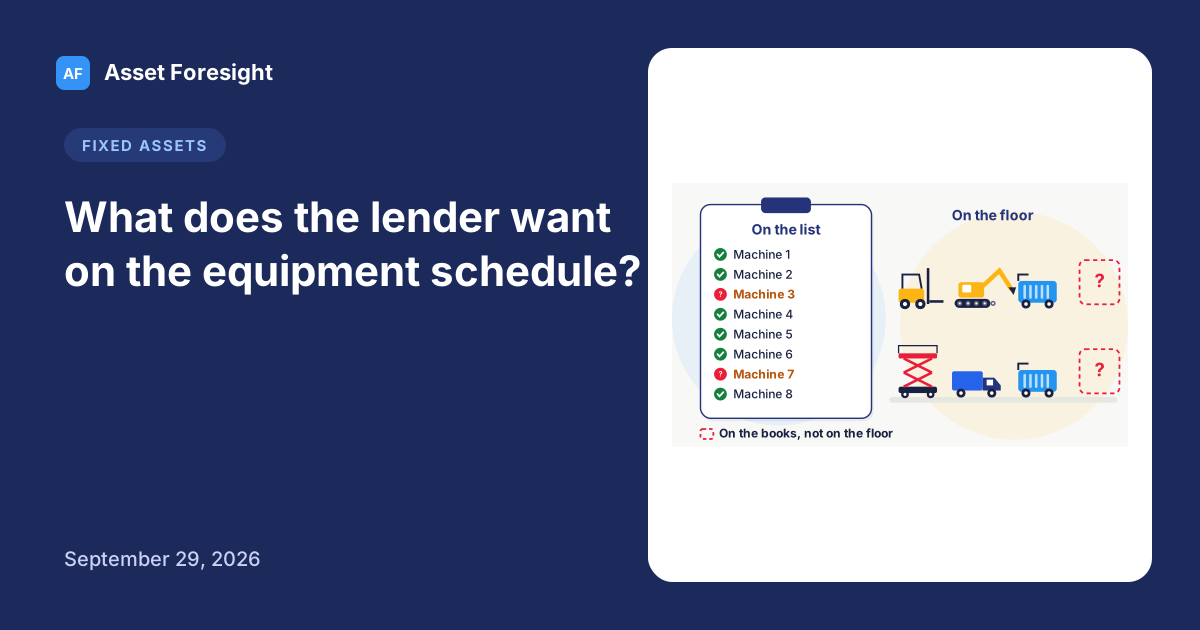
You have found a lender for your next batch of robots, and the terms look reasonable. Then the request arrives: "Please send over the equipment schedule."
Most founders open finance's spreadsheet and quickly realize it answers the wrong question. It lists model totals and depreciation, but it doesn't say which serial number is which, or where any machine physically sits.
An equipment lender finances physical collateral. The schedule tells them which machines they back. It is one line per asset, describing a unit someone could walk up to and touch. Each field must trace directly back to a document or a named decision.
Lenders ask for seven core fields: make, model, and revision; physical serial number from the plate; total capitalized cost (purchase price, freight, duty, rigging); in-service date; estimated useful life; current book value; and current physical location.
Take the rev-2 arm from last week. It cost $60,000 all in, went into service March 1, 2025, and was assigned a 36-month lifespan. That works out to $1,666.67 in monthly depreciation. By late September 2026, 19 months in, its net book value is $28,333.33. The schedule line reads: Arm, rev 2; $60,000 cost; in-service date 2025-03-01; 36-month life; book value $28,333.33; Test Cell 2, Main Building.
That line came from four documents and one decision: vendor invoice, rigging bill, delivery note, photo of the serial plate, and the 36-month lifespan choice. Book value changes monthly on a predictable schedule; location changes whenever someone moves the unit. That is where registers break down.
Approval is never guaranteed. In its July 2026 report, released August 25, 2026, the Equipment Leasing and Finance Association reported $14.3 billion in new business volume, with credit approvals dropping to 77.4 percent. You cannot control lender appetite, but you can control whether your schedule is verifiable.
A schedule true in January drifts by September through three routine events: a unit moves to a customer site for a demo, a unit is stripped for spare parts after failure, or a unit is retired while its row keeps depreciating. None sends finance an invoice; each leaves only an operational trace.
Under the hood, multi-agent systems solve this with multimodal computer vision and orchestration. An operator snaps a smartphone photo of the robot's stamped nameplate. A multimodal vision model serves as the system's eyes, extracting the etched serial number and hardware revision even under dim warehouse lighting. Each document (the PDF invoice, a repair bill) is read into fields and runs through the same fixed checks.
The system then builds an interactive schedule using Agent-to-User Interface (A2UI) technology. Rather than dumping raw text, it renders a structured schedule card. Each row carries its provenance: the record links back to the plate photo and to the attached vendor and rigging invoices.
Software agents automate document extraction, but a person makes every change. A human reviewer verifies the location, confirms the useful life, and signs off. When the lender asks where a number came from, that audit log is your instant proof.
On Monday, pick five machines at random. In ten minutes, try to locate five details for each: cost, in-service date, useful life, serial number, and physical location—along with the document behind each. Whatever you cannot find is your to-do list for the week. Start with location, because that goes stale fastest.
General information, not tax advice. Your accountant knows your situation.
Sources:
Wikipedia, "Computer Vision", 2024
A2UI Protocol Specification and Architecture, 2025
W3C, "PROV-Primer: An Introduction to the PROV Data Model", 2013